





Article Summary
The United States retains formidable advantages in space, but technological leadership is not self-executing. It must be financed, supplied, coordinated, and sustained.
Article Section
National Capacity Is a Strategic Asset
Fiscal policy, industrial production, mineral security, and space exploration are often discussed as separate subjects. In practice, they describe the same underlying capability: whether a country can marshal capital, technology, materials, institutions, and public support for objectives that require decades rather than quarters.
The connection begins with the federal balance sheet. The Congressional Budget Office projects a fiscal 2026 deficit of $1.9 trillion and debt held by the public rising from 101% of GDP in 2026 to 120% in 2036 under its baseline. Those projections do not dictate a specific policy response, but they illustrate a strategic constraint. Rising interest expense competes with discretionary spending and reduces flexibility when government must respond to security challenges, economic shocks, or major infrastructure needs.
For companies, the analogy is familiar. A business with limited liquidity and excessive leverage may still own excellent technology, intellectual property, and talent. Yet its capital structure can prevent it from investing at the moment opportunity arrives. National strategy is subject to the same discipline at a much larger scale.
Practical Takeaway
Economic discipline is not separate from national ambition. It determines how much ambition a country can finance and sustain.
Article Section
Space Is Becoming Infrastructure
Exploration has rarely remained a purely scientific activity. Maritime routes became commercial networks, ports, security commitments, and legal systems. Aviation produced airports, navigation standards, manufacturing ecosystems, and strategic reach. Space is following a similar progression.
The emerging space economy will depend on launch systems, communications, positioning, power, robotics, refueling, surface operations, resource use, and rules for coordinating activity. The countries and companies that build this infrastructure will influence not only commercial opportunity but also standards, security, and access.
This does not mean every space initiative should be viewed primarily through military competition. Scientific cooperation and peaceful exploration remain vital. It does mean that infrastructure creates durable advantages. Standards adopted early can shape who participates, how disputes are managed, and which technical systems become the default.
Article Section
The Competitive Landscape Is Already Taking Shape
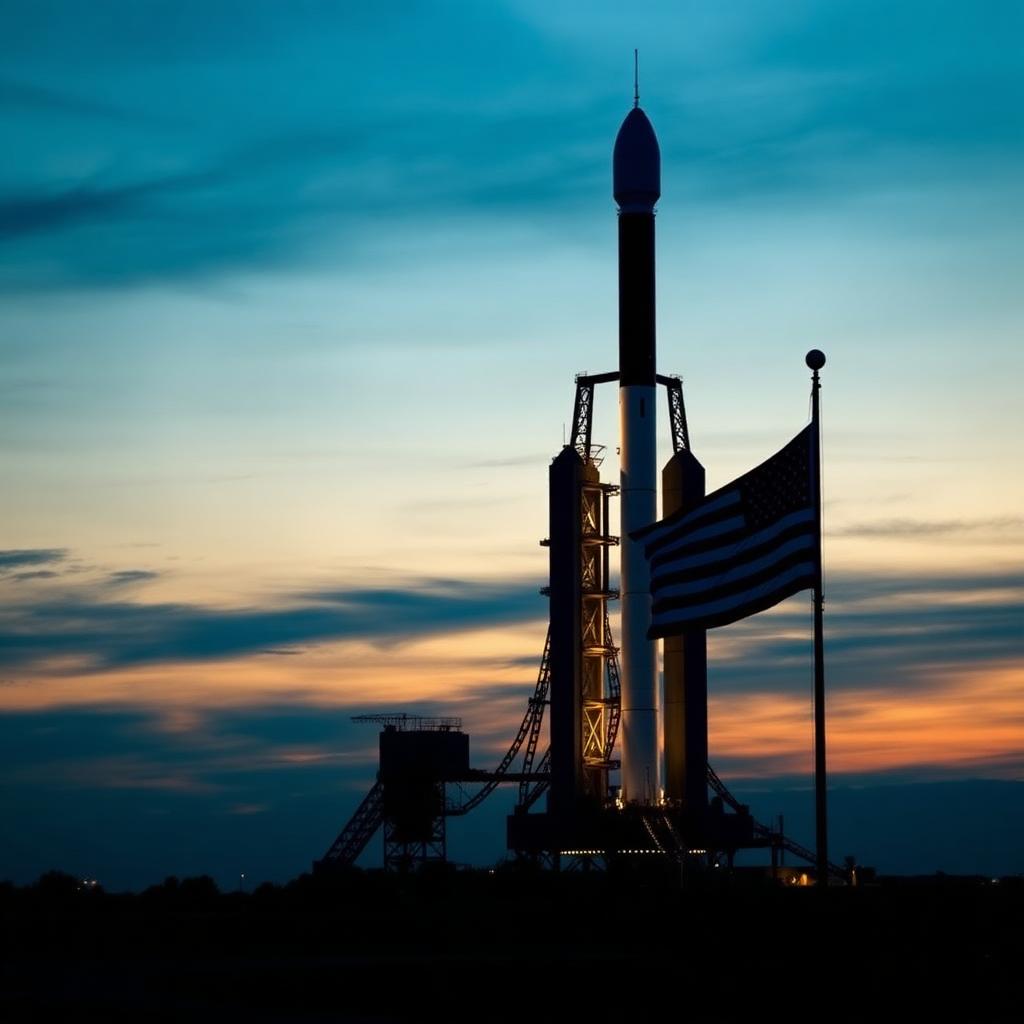
China’s program demonstrates the value of sustained national coordination. Its recent achievements include a permanent space station, the Chang’e-6 return of samples from the Moon’s far side, continued work toward lunar operations, and a rapidly expanding orbital presence.
The U.S. Space Force reports that China conducted 93 launches and placed approximately 370 payloads into orbit during 2025, ending the year with more than 1,353 satellites in orbit. Launch volume is not a complete measure of capability, but cadence matters: repeated missions strengthen manufacturing, supply chains, operational knowledge, and workforce experience.
The United States retains major advantages. It has a highly capable commercial launch sector, NASA, the Space Force, deep research institutions, substantial private capital, and a culture that can translate technical breakthroughs into scalable companies. The central risk is therefore not an absence of capability. It is fragmentation, short planning horizons, and failure to connect commercial innovation with a coherent industrial and international strategy.
Article Section
Critical Minerals Offer a Warning

Advanced manufacturing depends on reliable access to minerals, refining, components, and specialized production knowledge. The International Energy Agency found that the average share of the three largest refining countries for key energy minerals increased from approximately 82% in 2020 to 86% in 2024. Roughly 90% of refined-supply growth came from the leading supplier: Indonesia for nickel and China for cobalt, graphite, and rare earth elements.
High concentration does not automatically produce a shortage. It does create vulnerability to export controls, trade disputes, technical interruptions, and geopolitical pressure. Rebuilding capacity after a disruption is slower and more expensive than maintaining diversified capability before one occurs.
The space sector is exposed to the same industrial fundamentals as semiconductors, energy systems, and defense manufacturing. Launch vehicles and satellites require advanced electronics, magnets, batteries, propulsion systems, precision components, and materials whose supply chains cannot be improvised during a crisis.
Article Section
Robotics and In-Situ Resources Could Change the Cost Structure
A significant share of spaceflight cost comes from moving mass out of Earth’s gravity well. That is why in-situ resource utilization—the use of materials already available on the Moon, asteroids, or other bodies—could become strategically important.
Autonomous systems may survey terrain, process materials, maintain equipment, and construct basic infrastructure before people arrive. Some proposed concepts remain highly speculative, particularly self-replicating systems and large habitats built from asteroid material. Their immediate value is not as forecasts but as a different framework for investment: the objective may be to launch tools that build infrastructure rather than repeatedly launching every finished component from Earth.
Progress in autonomy, power generation, robotics, and in-space manufacturing can produce benefits well before the most ambitious concepts become practical. These are compounding capabilities, much like reusable launch systems: each improvement reduces the cost or increases the reliability of later missions.
Article Section
A Practical Agenda for Durable Leadership
A credible strategy requires priorities that survive electoral and market cycles.
- Improve fiscal flexibility so strategic investment is not continually displaced by rising debt-service costs.
- Prioritize reusable lift, in-space propulsion, refueling, surface power, robotics, and resource-utilization technologies.
- Create predictable legal and regulatory frameworks for commercial operations and resource use.
- Diversify mineral, refining, semiconductor, propulsion, and advanced-manufacturing supply chains.
- Use procurement and public-private partnerships to help hard technologies cross the gap between demonstration and commercial scale.
- Strengthen alliances through transparent, peaceful, and interoperable rules for civil space activity.
NASA describes the Artemis Accords as a common set of principles for safe, transparent, peaceful, and sustainable civil exploration. The framework matters because technical leadership and institutional trust reinforce one another. An international system succeeds when partners regard it as reliable, useful, and worth joining.
Article Section
The Business Lesson: Preserve the Capacity to Act
The strategic lesson also applies to companies. Excess leverage, concentrated suppliers, deferred maintenance, and dependence on a single technical platform can remain hidden during favorable conditions. They become decisive when conditions change.
Effective strategic advisory and turnaround planning begin before an emergency. Leaders identify constraints, protect liquidity, diversify critical dependencies, and fund capabilities that preserve future options. The same discipline applies whether the subject is a middle-market company or national industrial policy.
The United States does not need to manufacture a crisis to justify serious preparation. It already possesses the technology, institutions, and entrepreneurial capacity to lead. The task is to organize those advantages around a sustained objective and avoid allowing short-term comfort to erode long-term freedom of action.